Last time we talked about Real World Assets (RWA), we explored three different approaches to bringing off-chain assets onto the blockchain. One of the rising stars at the time was Mantra, a Layer 1 blockchain based on the Cosmos SDK and designed specifically to support the growing RWA narrative.
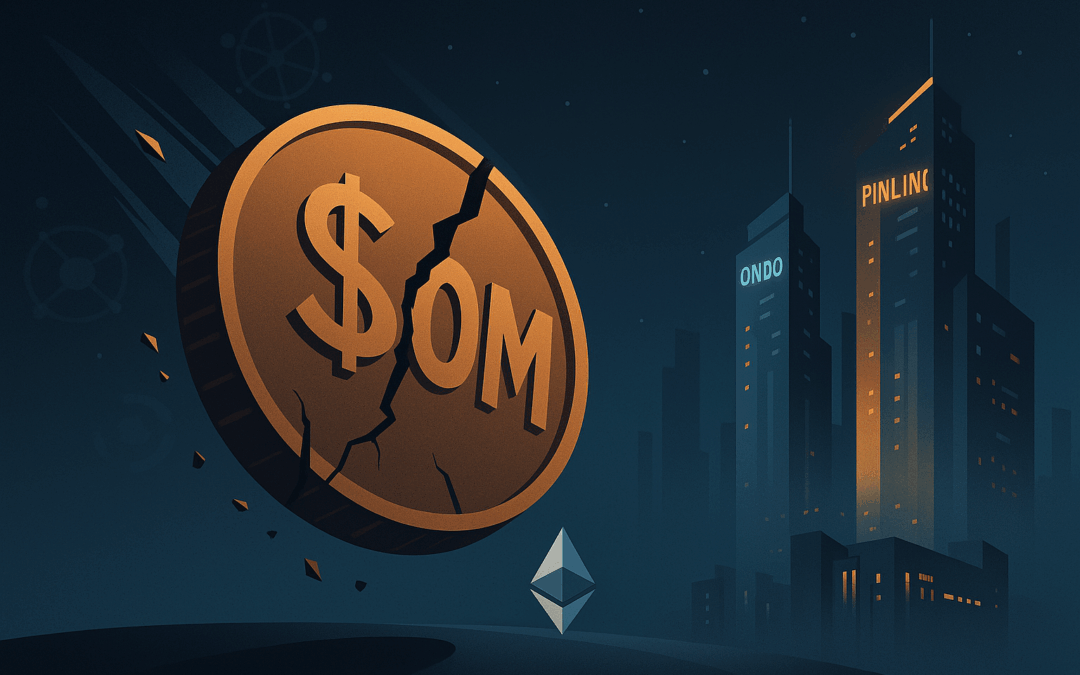
Fast forward to last week — despite announcing promising partnerships and development milestones, $OM, the native token of Mantra, dropped as much as 90% in a matter of days. What went wrong? And more importantly, what does it tell us about the current state — and future — of RWA in crypto?
What Went Wrong with Mantra?
Mantra entered the spotlight with all the right ingredients: a slick narrative around real-world assets, low float/high FDV tokenomics, and apparent traction in the Middle East. But like many new Layer 1s, it faced the challenge of maintaining momentum ahead of large token unlocks — a period that often brings volatility and uncertainty.
It appears that efforts to support the token’s price — whether through coordinated market activity or organic trading — may have fallen short. With thin liquidity and a small circulating supply, once confidence wavered, the market had no cushion. The price collapsed, and there was little natural demand to absorb the sell pressure.
Investors largely overlooked that Mantra was essentially a fork of Cosmos with some custom RWA-focused modules. Many chased the narrative, ignoring fundamentals and better-positioned competitors. The result was a hard reset for both the project and its supporters.
Do We Really Need a Layer 1 for RWA?
Here’s the question more people should have asked earlier: Do RWAs need their own blockchain at all? Most users would rather have their tokenized assets — whether it’s real estate or T-bills — on Ethereum or a major L2, not on a niche chain that might not survive the next market cycle.
Why?
Security: Ethereum has the most battle-tested smart contracts and validator network.
Ecosystem support: Integrations with wallets, exchanges, and DeFi protocols already exist.
Longevity: Institutional players want to know their assets will outlive a startup chain.
Launching a custom L1 adds technical debt, fragmentation, and regulatory risk — without necessarily adding user value. Unless there’s a truly novel consensus or compliance mechanism, building on Ethereum (or even leveraging modular frameworks like Celestia or Rollups) is a smarter path.
Tokenomics & Transparency: Lessons Learned
One of the biggest takeaways from Mantra is the importance of token design and transparency. Many crypto projects continue to launch with:
Low circulating supply
High insider allocations
Poorly communicated unlocks
Artificial price support via market makers
These setups are unsustainable. They create the illusion of value — until tokens unlock or sentiment shifts. Then, they unravel fast. Going forward, both builders and investors need to demand clear unlock schedules, publicly auditable wallets, and honest disclosures about how much supply is under team or investor control.
What Real Innovation in RWA Looks Like
The real challenges in RWA aren’t about spinning up a new chain — they’re about solving the messy real-world problems like:
Regulatory compliance (KYC/AML)
Reliable asset custody and legal wrappers
On-chain identity and registries
Permissioned smart contracts for institutional access
The projects that succeed in this space will be the ones building compliant, composable infrastructure — not just hype-driven chains. Expect more focus on oracles, metadata standards, and identity layers rather than yet another Layer 1.
Will RWA Really Generate Revenue?
Let’s do some simple math on whether RWAs are actually profitable — and for whom.
💰 Hypothetical Revenue Breakdown:
$1B in tokenized assets
0.5% origination fee → $5M one-time
0.25% annual management fee → $2.5M/year
$100M traded monthly at 0.05% protocol fee → $600K/year
That’s around $8.1M in Year 1 revenue — from just $1B in assets.
Scale that to $10B, and now you’re looking at a legitimate eight-figure revenue stream.
🤔 But Here’s the Catch:
Most RWA protocols don’t own the custody or origination.
If you’re just a blockchain, how much of this fee flow do you actually capture?
You need users, developers, and legal infrastructure — not just tokenomics.
Real revenue in RWA exists — but only if you own key parts of the stack.
Who’s Building the Next Phase of RWA?
Here are some of the most promising players leading the way — along with the tech they’re using and the risks they face.
📌 Pinlink
What It Does: Asset identity registry — think ENS for real-world things.
Tech: Built on Ethereum. Uses IPFS and NFTs to link physical assets to legal metadata.
Risks: Still early. Legal enforceability of claims may be untested in court. Competing projects may enter.
💵 Ondo Finance
What It Does: Tokenized securities, starting with U.S. Treasuries (OUSG).
Tech: Ethereum-based. Leverages real custodians (e.g., BlackRock) and whitelisted smart contracts.
Risks: Highly dependent on U.S. regulatory clarity. Centralized custody is a risk.
After some quiet months, Ondo is gaining attention again thanks to its institutional-grade tokenized T-bills (OUSG) and expansion into APAC markets. With Coinbase and BlackRock nods, they’re positioning as a credible bridge for TradFi.
⚙️ Chex
What It Does: Tokenizing commodities and logistics assets (e.g. oil, metals, grain).
Tech: Multi-chain — using Ethereum and Polygon, with Chainlink for data oracles and RFID integration.
Risks: Logistics infrastructure is messy. Data integrity is critical. Institutional adoption may lag.
🏗️ Centrifuge
What It Does: RWA lending with real-world collateral (e.g. invoices, real estate).
Tech: Built as a Polkadot parachain with Ethereum bridging. Uses NFT-based asset tokenization.
Risks: Less visibility outside Polkadot. Loan performance depends on off-chain enforcement.
🪙 Maple Finance
What It Does: On-chain undercollateralized lending for institutions, now expanding into RWA credit lines.
Tech: Ethereum and Solana-based. Uses smart contracts and pool delegates for underwriting.
Risks: Credit risk. Some past defaults. Regulatory friction with unsecured lending.
🧭 Where Do We Go From Here?
The Mantra saga should be a turning point. The RWA narrative is real — it’s not just hype — but it needs infrastructure, not speculation. What comes next?
Shift from L1s to middleware and application layers
Focus on compliant infrastructure, not forks
RWA liquidity pools, registries, and oracles > empty chains
Real revenue, not token inflation
Mantra may have fallen, but the future of RWA is still very much alive — and maybe this reset is exactly what the space needed.
As the world increasingly embraces artificial intelligence and blockchain technology, innovative protocols are emerging to bridge the gap between these two transformative fields. One such innovation is Wayfinder.ai, a decentralized, omni-chain protocol designed to enable AI agents to interact seamlessly with multiple blockchain ecosystems. Let’s dive into what makes Wayfinder.ai unique and how it’s shaping the future of decentralized AI.
What is Wayfinder.ai?
Wayfinder.ai is not a standalone blockchain but a cross-chain protocol that operates across various blockchain networks like Solana, Ethereum, and Base, with plans for further expansion. Its primary goal is to facilitate AI integration into blockchain environments by allowing users to create and deploy AI agents. These agents can execute complex tasks such as trading, minting, deploying smart contracts, and more, following predefined workflows known as “Wayfinding Paths.” By supporting multiple chains, Wayfinder ensures that AI agents can operate in a decentralized, interoperable, and efficient manner. This makes it a powerful tool for developers and organizations looking to harness the combined potential of AI and blockchain.
Airdrop Opportunities
Wayfinder has launched an airdrop campaign for its $PROMPT token, with 40% of the total supply allocated to the community. This includes:
Free Signup: 1% of the $PROMPT supply is reserved for users who register on the platform.
Staking $PRIME Tokens: 39% of the supply is distributed to users who cache (stake) their $PRIME tokens. Longer staking durations yield higher rewards.
To participate:
Free Signup:
Register on the Wayfinder platform and verify your account by following this link.
Create a passkey and secure your mnemonic phrase.
Engage with the platform to maximize rewards. You will get an ethereum and solana address. You can deposit funds to any of the chains, but this might not be a pre-requisite.
Staking $PRIME Tokens:
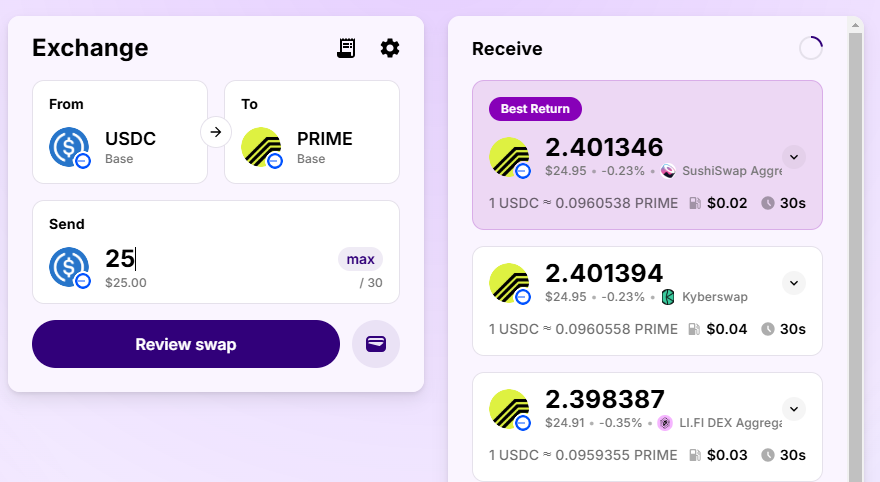
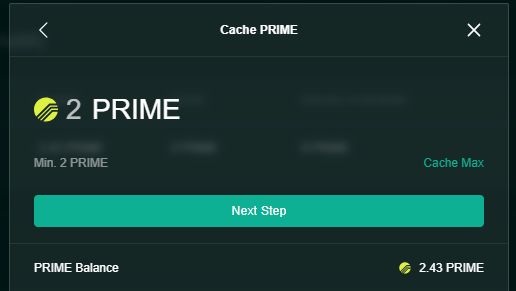
Purchase $PRIME tokens from supported exchanges (Minimum of 2 $PRIME is required).
You can use your favorite DEX like jumper.exchange, bungee.exchange, lanca.io, etc…
To minimize fees, you can swap for $PRIME on the base network. Double check the address on coinmarketcap.
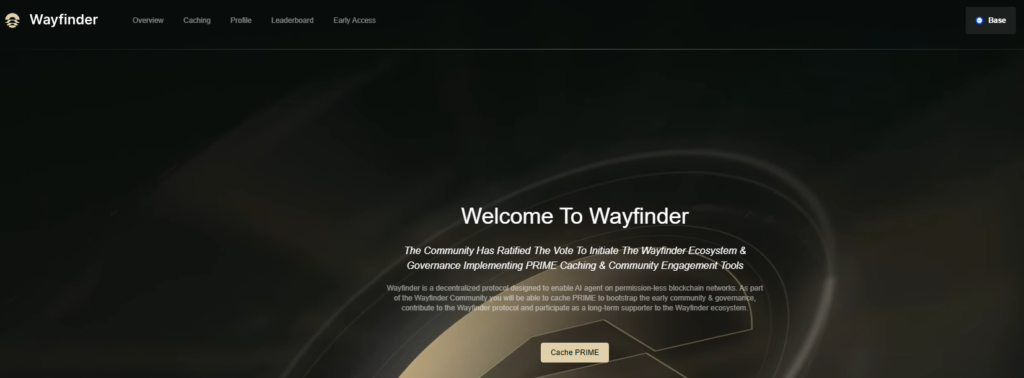
Connect your wallet to the Wayfinder caching platform by following this link.
Switch to the Base network on the top right corner of the screen
Stake your tokens and earn rewards over time.
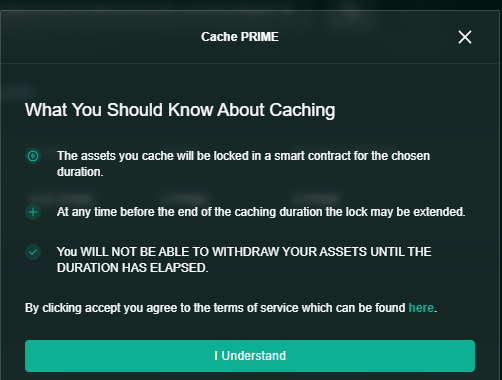
Please ensure that you review the terms and understand that you won’t be able to access your tokens until the lock period concludes.
Don’t forget to do your own research and understand smart contract risks.
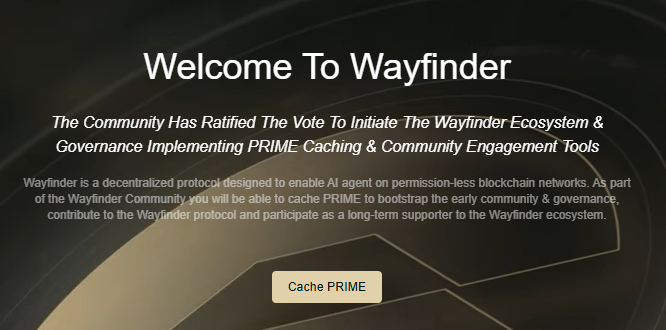
Here are the steps for caching $PRIME:
Exchange on jumper
Follow the link, connect your wallet and switch to Base
Click on Cache PRIME
Review the terms
Specify the amount
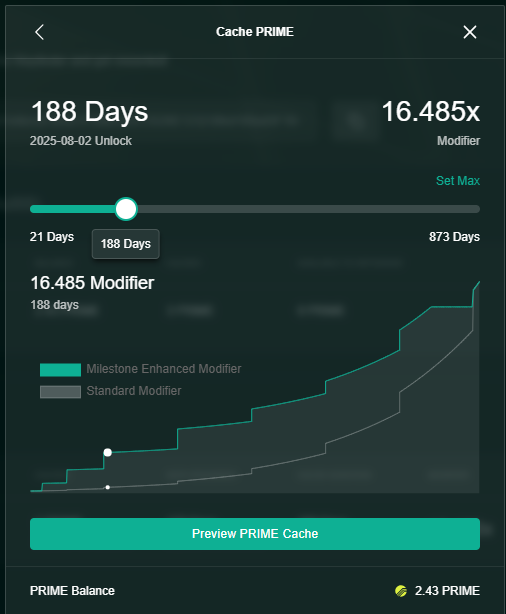
Choose your lock period. The longer the lock period, the better the multiplier. However, keep in mind that your $PRIME tokens will be locked. If there’s a bull run and your tokens are locked, you won’t be able to sell them. You can opt to lock different amounts of $PRIME for various periods to balance your risk and reward.
Key Features and Capabilities
Cross-Chain Operability: Wayfinder enables AI agents to interact across multiple blockchain networks, leveraging the strengths of each ecosystem. This omni-chain approach ensures flexibility and scalability for AI-driven applications.
Integration with $PRIME Token: The protocol is developed by the team behind Parallel TCG, a blockchain-based trading card game. Within Wayfinder, the $PRIME token serves as a foundational asset. Users can stake (“cache”) $PRIME tokens to earn $PROMPT tokens, which are utilized for protocol functions and incentives.
Decentralized AI Workflows: AI agents within Wayfinder follow structured “Wayfinding Paths,” predefined workflows that guide them in achieving specific objectives across blockchain environments.
Community-Driven Incentives: Wayfinder actively rewards community participation through staking, engagement, and airdrop campaigns, fostering a robust and active ecosystem.
The Future of AI and Blockchain Integration
Wayfinder’s innovative approach to integrating AI agents within blockchain environments paves the way for new possibilities in decentralized applications. By leveraging $PRIME tokens and incentivizing community engagement, the protocol aligns its growth with the interests of its users. With its omni-chain capabilities and robust risk management framework, Wayfinder is set to become a cornerstone in the evolving landscape of decentralized AI.
Decentralized Finance (DeFi) has unlocked innovative financial models, yet it remains susceptible to significant risks, especially during market downturns. This article explores recent challenges faced by THORChain (RUNE) and Kujira (KUJI), analyzes synthetic asset models, and compares ENA’s approach to Maker’s DAI.
THORChain (RUNE): Collateral Risks and Debt Spiral
THORChain’s recent challenges highlight the dangers of relying on a native token as collateral. The protocol’s innovative lending model involves:
Collateral Conversion: Users deposit assets like BTC or ETH, which are sold for RUNE. By burning RUNE, the system aimed to keep its price up, which helped to offer loans without requiring liquidation, reducing risks for borrowers and encouraging them to keep their position.
Loan Repayment: When loans are repaid, RUNE is minted to repurchase the original collateral from the market.
What Went Wrong?
Market Dependency: RUNE’s price decline created a debt spiral. As liabilities exceeded the value of burned RUNE, minting more tokens caused further devaluation, undermining confidence.
Inflationary Pressure: The reliance on RUNE as both the collateral and liability instrument proved unsustainable during a bear market.
Lender Awareness: Many lenders likely did not fully understand how their assets were being used in this system, which underscores the importance of conducting thorough due diligence (DYOR) before participating in DeFi protocols.
This design reveals the vulnerabilities of self-referential token systems, particularly in volatile markets.
Kujira (KUJI): Governance and Operational Risks
Kujira’s collapse of operational funds due to on-chain liquidation underscores governance risks. The Kujira Foundation:
Leveraged KUJI: The Foundation used KUJI—primarily sourced from the protocol’s operational treasury—as collateral to secure loans.
Liquidation Event: Market volatility led to under-collateralized positions, triggering forced liquidation on its own platform. The price of KUJI plummeted, eroding investor confidence.
Connection with THORChain: Kujira has partnered with THORChain to explore a shared DeFi application layer, but the financial issues of both protocols highlight the need for robust collaboration and risk management.
Lessons Learned:
Collateral Management: Overleveraging native tokens can destabilize protocols.
Governance Transparency: Community-driven treasury management may reduce single points of failure.
From Collateral Risks to Synthetic Assets: Evaluating ENA (USDe)
Synthetic assets aim to bring stability and utility to DeFi ecosystems. ENA introduces a novel approach:
Mechanism: ENA creates a synthetic dollar by pairing long and short positions on perpetual markets.
Utility: ENA enables decentralized trading and hedging strategies while maintaining a stable synthetic asset for DeFi use cases.
Non-Self-Referential Model: Unlike systems such as Luna’s UST, ENA does not rely on its native token to stabilize its synthetic dollar, reducing the risk of a death spiral.
Governance and Utility of the ENA Token
ENA’s governance token serves multiple purposes within its ecosystem: Governance: Token holders can participate in decision-making processes, such as adjusting protocol parameters or introducing new features. Utility: Beyond governance, the token may be used for staking, rewarding participants, or providing incentives for liquidity providers, ensuring the protocol’s smooth operation.
Comparison with Luna
Luna’s UST relied on a self-referential model, where Luna was burned to mint UST, leading to catastrophic devaluation during market stress.
ENA avoids this by using a market-based approach where long and short positions balance each other, making it less susceptible to runaway feedback loops.
Risks in Bear Markets
Low Market Activity: During downturns, demand for long positions declines, reducing funding fees for shorts.
Sustainability: Without sufficient short incentives, the synthetic dollar could lose its peg, leading to instability.
ENA’s reliance on active market participation remains untested in prolonged bearish conditions. However, Ethena employs a robust risk management framework to ensure the stability of its synthetic asset, USDe. This includes strategies such as over-collateralization to mitigate liquidation risk, utilizing a delta-neutral approach to manage funding risk, and partnering with secure custodians for asset safety. Additionally, Ethena’s treasury backstop functions as a reserve fund to provide liquidity and support during market volatility, ensuring financial stability. These measures collectively strengthen the protocol’s resilience, protecting users from potential risks and market disruptions. It will be interesting to see how it performs during the next bear market.
Comparison: ENA vs. DAI (Maker)
Both ENA and Maker’s DAI represent synthetic asset models, but their mechanisms differ significantly:
Feature
USDe (ENA)
DAI (Maker)
Collateral Model
Long/short positions in perpetual markets.
Overcollateralized loans with crypto assets.
Stability Mechanism
Funding fees balance long and short positions.
Peg maintained via liquidation of collateral.
Bear Market Resilience
Vulnerable to low market activity and funding.
Stronger due to overcollateralization buffer.
Collateral Volatility
Relies on market activity for synthetic dollar.
Sensitive to collateral price fluctuations.
Adoption History
New and largely untested in bearish conditions.
Proven track record through multiple cycles.
Historical Context for Maker
Maker has demonstrated resilience through multiple bear markets. By leveraging overcollateralization and robust risk management, the protocol has successfully maintained DAI’s stability even during extreme market volatility, highlighting its maturity and reliability.
Utility and Governance of the Maker Token (MKR)
The Maker token (MKR) plays a vital role in the DAI ecosystem:
Governance: MKR holders vote on critical protocol decisions, such as adjusting collateralization ratios, introducing new collateral types, and setting stability fees.
Utility: MKR acts as a backstop for the system. In case of under collateralization, new MKR tokens can be minted and sold to cover the deficit, ensuring the stability of DAI.
This dual functionality ensures that MKR holders are incentivized to maintain the protocol’s stability and efficiency.
Key Takeaways:
ENA Strengths: Dynamic balancing of long and short positions introduces a new paradigm but is highly dependent on market activity.
DAI Strengths: Overcollateralization and automated liquidations make it more robust in adverse market conditions.
Conclusion: Navigating DeFi Risks
The challenges faced by THORChain and Kujira, along with the experimental nature of synthetic asset models, underscore the vulnerabilities in DeFi. Diversifying collateral types, implementing robust governance, and preparing for bear markets are essential to ensure long-term sustainability. Mitigation strategies such as building reserve funds, incentivizing liquidity, and introducing insurance mechanisms can help protocols navigate extreme conditions while maintaining user confidence. As DeFi evolves, the lessons from RUNE, KUJI, ENA, and Maker demonstrate the need to balance innovation with risk management, paving the way for a more stable and mature ecosystem.
The beginning of 2024 saw the emergence of multiple layer2; each promising to scale Ethereum, offer a high transaction throughput and reduce network fees. We will go over the major solutions and compare their performance.
The beginning
Polygon (Matic) was the first layer2 to get mass adoption. It is designed to improve the scalability and efficiency of Ethereum by offering faster and cheaper transactions while retaining the security and decentralization of the Ethereum blockchain. Polygon acts as a Proof of stake sidechain that does commit all transactions to Ethereum. It uses a technique called checkpointing to periodically batch and commit information about the state of the sidechain (transaction summary) to the Ethereum.
Zero-Knowledge Proofs
Zero-knowledge proofs are a well-established cryptographic concept that has been researched and developed by cryptographers for several decades. ZK-proofs are based on the idea that a party (the “prover”) can demonstrate to a different party (the “verifier”) that a statement is true without disclosing any specifics about the information itself. ZK-Rollup solutions will be developed by many players for scaling Ethereum
Polygon zkEVM
In order for Polygon to offer all the benefits of Ethereum’s security and compatibility with existing smart contracts, a new zkEVM solution is offered. zkEVM is a specific implementation of ZK-proofs on Ethereum Virtual Machine. The focus shifts to using ZK-proofs to commit transactions directly to Ethereum in a more efficient and secure way, rather than relying on periodic checkpoints. Polygon is not moving entirely to zkEVM but rather positioning it as one of several options within its broader ecosystem.
zkSync
zkSync uses ZK-Rollups but incorporates a unique virtual machine and transaction logic to optimize for scalability and developer flexibility. zkSync aims to provide compatibility with many Ethereum-based tools and smart contracts, but it does so by using a custom virtual machine called the zkSync VM. Since it’s a custom VM, developers might need to make slight modifications to their smart contracts. zkSync focuses on providing a developer-friendly environment while striving to support more advanced features. It is not as deeply tied to Ethereum’s architecture as zkEVM. zkSync is focused on more complex use cases such as account abstraction and native layer3 support.
Polygon POS vs zkEVM vs zkSync
Transactions fees on zkEVM and zkSync are paid in ETH. This lowers the demand on the native tokens MATIC and ZK. Polygon POS still uses MATIC as its transaction fee token.
MATIC will be migrated to POL. The goal is to use it as a core utility token that can help secure and scale multiple chains inclusing zkEVM. POL’s primary goal is to be used for staking to secure all of Polygon’s chains and may be used as a transaction token.
zkSync just launched its native token ZK. For now, it is mostly a governance token that allows users to vote on protocol upgrades. It is used for staking and securing the network, but it’s still not used for transaction fees. It might be used to pay for transaction fees on the different chains that launch of zkSync, so its future depends on new interconnected ZK chains.
The price of ZK token has not performed well following the airdrop, probably because of lack of utility. The migration from MATIC to POL did not help the token gain in value. POL and ZK have a potential, but they greatly depend on the chain’s adoption. Polygon will be more suited for general purpose applications while Zksync will be more suited for specific applications.
Let’s do a comparison of Polygon vs Zksync:
token price
total supply
Fully diluted Market Cap
TVL
zksync
0.13$
21b
2.6b
136M
Polygon
0.38$
10.2b
3.9b
900M Polygon + 14M Zkevm
In terms of zk technology, we can see that zksync has more adoption, while polygon relies more on its legacy. However, both chains are facing stiff competition.
Optimistic rollups
Optimistic Rollups is a Layer 2 scaling solution that garnered considerable interest due to its ability to process more transactions efficiently while utilizing Ethereum’s security. Unlike ZK-Rollups, which employ cryptographic proofs for transaction validation, Optimistic Rollups operate on the premise that transactions are inherently valid but incorporate a dispute resolution mechanism (fraud proofs) to address any disputes. If a transaction is fraudulent, the fraud proof triggers a challenge period, and the invalid transaction can be reverted. ZK-Rollups deliver quicker finality by eliminating the challenge period. On the other hand, Optimistic Rollups are typically more convenient for developers to develop and maintain in terms of EVM-compatibility, making them more developer-friendly in the immediate future.
Optimism and Arbitrum One
Both optimism and arbitrum are implementations of Optimistic rollups. Both are very fast, low fee and more fluid to use compared to zkSync. Let’s compare them:
token price
total supply
Fully diluted Market Cap
TVL
Optimism
1.6$
4.3b
6.8b
640M
Arbitrum
0.55$
10b
5.5b
2.4b
Considering the total supply, OP token is performing better than ARB token, however Arbitrum has much more adoption. This might be because OP is considered by many as an exposure to the Base network. Both chains use ETH as transaction fee, which makes their token more of a governance/staking rather than a utility token.
Superchains
Optimism developed the OP stack, which is an open source modular framework developed that enables the creation and deployment of custom Layer 2 solutions (or Optimistic Rollups) on Ethereum. It is part of Optimism’s vision of a superchain to foster a vibrant ecosystem of Layer 2 networks, allowing developers to easily build their own scaling solutions tailored to specific use cases. The OP token does not benefit directly from the OPStack.
We can find a similarity with the Cosmos ecosystem, where blockchains can use Cosmos to spin off new interconnected chains. The ATOM token was not directly benefiting from the ecosystem growth. Some proposals were made to inscease the utility of the ATOM token, but it did not have a great traction so far. OP and ATOM token both get their value from speculation and their future role in their ecosystem. For example, while Base network reached a profit sharing agreement with Optimism, it does not translate directly to profits for the OP token.
Arbitrum orbit offers an alternative to the OPstack that enables developers to create and deploy custom Layer 2 solutions (also known as rollups) on the Arbitrum ecosystem.
Base and Mode
Base and Mode are two chains that are developed using the OPstack. While Base is developed by Coinbase with a goal of mass retail adoption, Mode is a chain dedicated initially for gaming.
token price
total supply
Fully diluted Market Cap
TVL
Mode
0.01$
10b
112M
303M
Base
No token
–
–
2.24b
We can see that the Mode network is not getting much traction. Most of the remaining TVL is temporary and aiming at the season 2 of the airdrop. Season 2 will dilute the token even more. Mode has received many fundings from optimism and it’s switching its narrative to AI-powered financial applications. This new niche might help it recover for the future.
Base continues to attract widespread retail adoption despite not offering an airdrop. Its achievements can be attributed to effective marketing strategies, a reliable network, and the adoption of meme coins. Although Scroll and Linea incentivize liquidity provision with airdrops, Base’s higher Total Value Locked (TVL) sets it apart as a network.
Linea and scroll
Linea and Scroll are the two leading zkRollup solutions. Scroll is more focused on zkEVM for full compatibility with Ethereum. Linea is developed by Consensys, a leading blockchain software company, which works on products like MetaMask and Infura. As of today, Linea is more fluid than Scroll.
Both have a competing airdrop campaign which is supposed to attract a lot of liquidity. Linea expecting as much as 3b. However, Linea has a 500 M TVL while Scroll has around 700M. This TVL does not compare this the 2.24b that is locked at Base, which does not offer a clear airdrop. Most of the TVL in Linea and Scroll will probably go towards newer projects once the airdrop campaigns end.
Mantle
Mantle is an optimistic rollup layer2. Mantle’s primary use cases include supporting DeFi applications, NFT platforms, and gaming dApps that require fast, low-cost transactions while maintaining security.
token price
total supply
Fully diluted Market Cap
TVL
Mantle
0.6$
6.2b
3.7b
415M + 1.2b ETH LRT
Mantle looks like a strong contender in the layer2 market. It was able to capture a good chunk of Ethereum’s LRT market with its meTH token and the COOK airdrop. Mantle’s marketing around the PUFF meme coin was brilliant. Another distinction is the usage of MNT token for transaction fees, which shows confidence at this early stage.
Dapps are launching their own chain
An increasing number of decentralized applications (dapps) are opting to create their own blockchain. This gives them more options and adaptability for their offerings. For instance, prominent decentralized exchanges (DEXs) and perpetual exchanges are establishing their blockchains. Logx has launched using the Arbitrum orbit stack, while Aevo is utilizing the OP stack. This move will strengthen the positions of both Arbitrum and Optimism as superchains rather than just Layer 2 solutions. The success of their respective tokens within the Superchain ecosystem will be crucial in determining their success, as the primary focus now lies in innovation rather than revenue generation.
Upcoming Layer2 – Does the market need more solutions?
New Layer2 projects such as Mintchain, redstone, fraxtal, ZetaChain, and Taiko are emerging. Each chain is targeting a specific market niche and many of them are built on a superchain. Platforms like Dymension are simplifying the process of launching new rollups. The market is rapidly becoming saturated, while Solana continues to thrive without requiring layer2 solutions. Several layer2 projects on Ethereum are expected to shift their focus to serve as a layer2 solution for Bitcoin. The layer2s that will stand out after the bull run and airdrop hype are over will probably be Base, Mantle and Linea.
The $COOK token is the future governance token for Mantle’s LRT token $mETH. Mantle eth is an LRT similar to EtherFi’s eeth implemented by Mantel. $mETH appreciates over time from staking and restaking rewards.
We will go through 4 easy ways to farm the $COOK airdrop.
Methamorphosis campaign
The first step is to register to Metamorphosis campaign and start accumulating powder. You can accumulate powder by simply holding mETH in your wallet. You can get multipliers by participating in DEFI. Depending on your risk tolerance, you can also loop your assets and use leverage to maximize your powder. You can also deposit mETH in Karak (invite code absd6, Egi8A) and farm Karak at the same time.
Mantle reward station
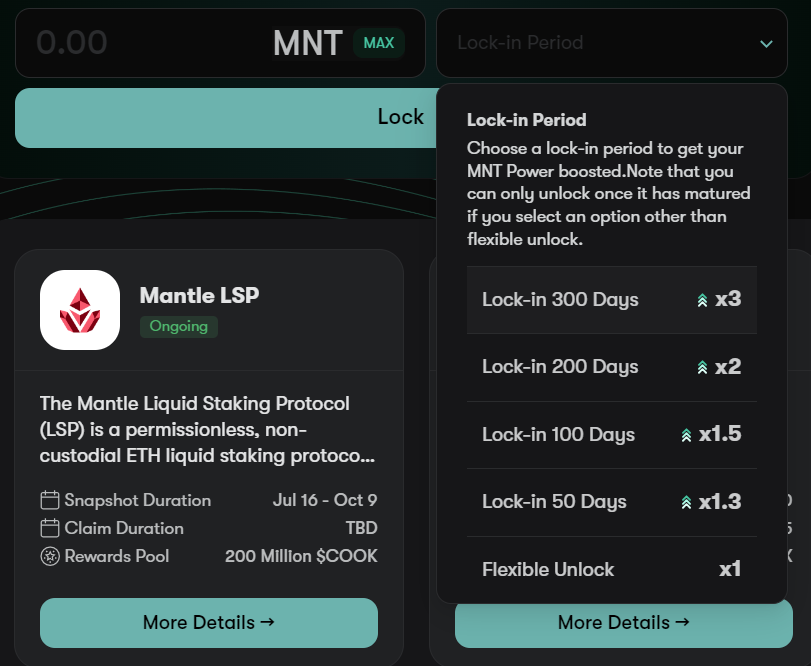
If you are bullish on Mantle’s MNT token, you can head to Mantle’s reward station and lock your tokens. The longer you lock your tokens, the more rewards you get. By using the reward station, you know exactly how many COOK token you are getting every day. With the Methamorphosis campaign, we still don’t know the conversion rate between powder and COOK.
Pendle.finance
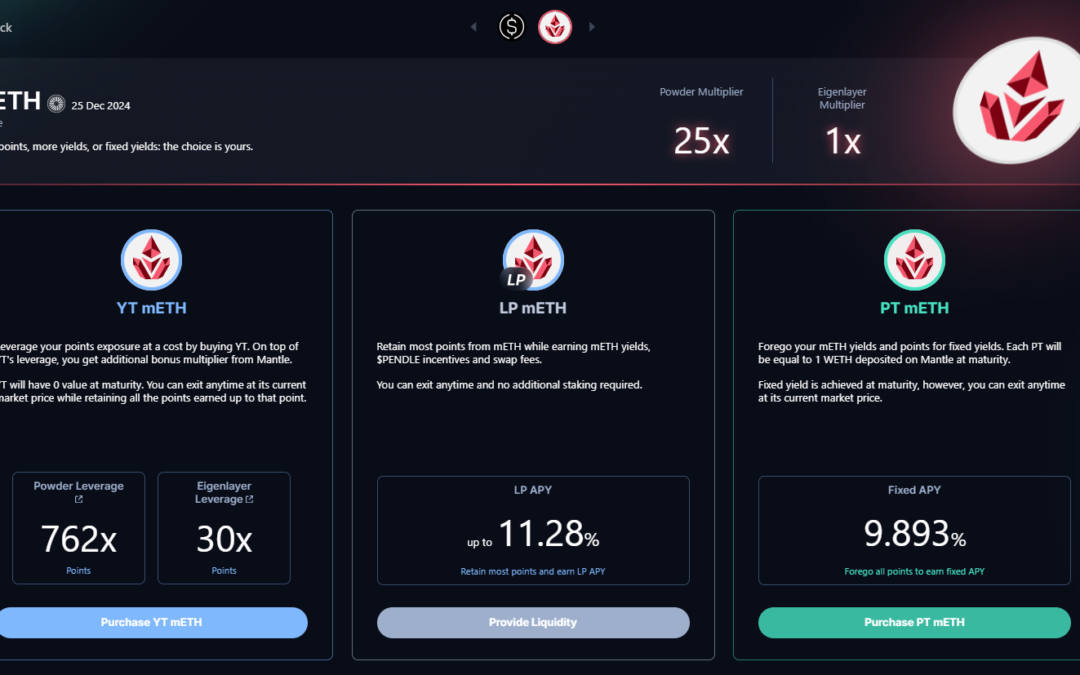
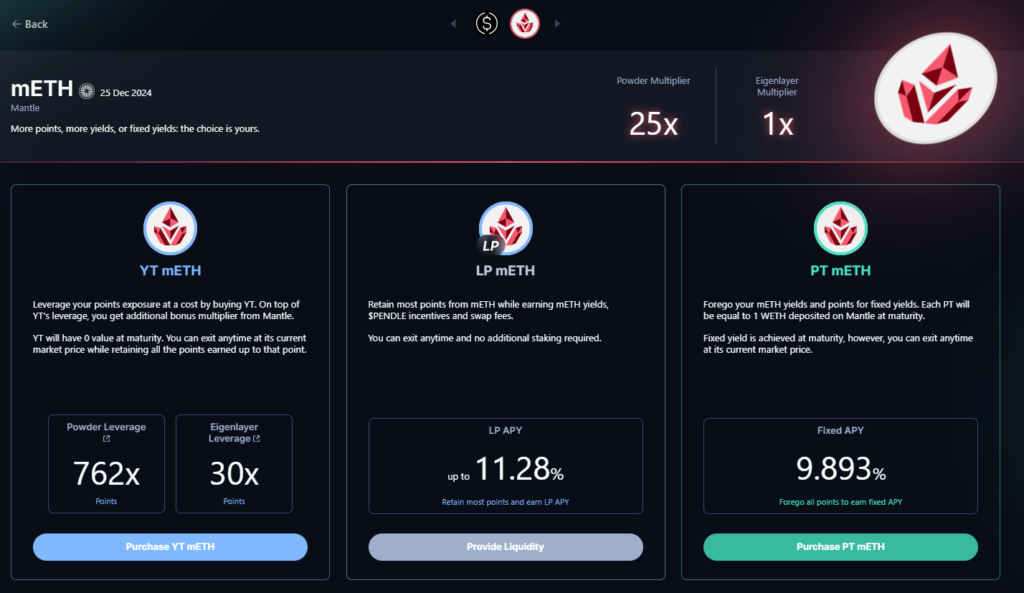
You can participate in pendle’s liquidity pools for an extra multiplier. With pendle, you have the interesting YT option where you can literally “buy” points. So by buying even a small portion of YT, it is equivalent to depositing a much larger amount of mETH. However note that any YT you buy will have 0$ value at maturity (25 dec) and the value decreases every day, so you are literally buying powder.
$PUFF token
A portion of the $COOK token will go to the PUFF community. So holding the $PUFF token might make you eligible for the $COOK airdrop, however, we do not know if there’s a minimum to hold, what is the earning potential or whether you will have to exchange your PUFF for COOK. However if you are bullish on PUFF, it might be a good option.
Don’t forget to do your own research since there’s a lot of layers of risk involved in farming.
Layer3 offers unique interactive experiences that help users discover new blockchain protocols and earn via perpetual incentives. By completing quests, users get the chance to interact with new token less protocols and get the chance to be eligible for future airdrops while building their online identities.
For new projects, Layer3 offers an engaging platform where they can build their communities, drive adoption and network growth. Layer3 has many solid competitors, however it distinguishes itself with smaller easy to complete quests.
Layer3 and Mercle both have hinted that they are aiming for a decentralized model that is user owned. This means that a potential airdrop is possible. For layer3, to be eligible, you will have to complete at least 100 quests that offer a CUBE NFT. Each cube costs around 0.25$ excluding network fees. To complete each quest, you will have to complete some tasks on different platforms, provide liquidity, do some bridging, some swapping, etc…
Each quest will have a cost and a small capital will be needed. On average, you should expect to burn between 100 to 200$, so you will have to do your own research and see if it’s worth it to embark on this journey. As of today, there’s 18 days left for season 1. It’s important to note that the first 100 cube will get you eligible for season 1, so you will have to expect more seasons to follow. Once the 100 cubes are collected, you will get the following message:
Comparison
What would a future token be worth? It’s impossible to predict, but let’s compare with Galxe which already have a token:
Users: 17M users for Galxe versus 1.1M for Layer3
Layer3 has over 49M quest completion, while Galxe has over 73k campaigns launched by 5k different brands.
We can see that Galxe is more advanced than layer3 and it offers more products such as a galxe passport for sybil protection.
Presently Galxe’s token is worth 4.32$. It is up from the 1$ range during the bear market. It has 200M total supply with 50% of the tokens already in circulation. The market cap is around 0.5b with a diluted market cap of 0.86b.
While it is not clear what is the net revenue of Layer3 or Galxe, so the token price is based solely on speculation. However GAL token is used for the following:
Governance token
Paying for application module fee
Paying for Galxe oracle engine and credential API
Curating Digital credentials
We can see that the GAL token is not simply a governance token, but is also a utility token used to pay for Galxe core services. This could drive the price up when Galxe services are in high demand. So the platform adoption is directly correlated with the token price.
Most of the protocol fee will go to credential curators and the rest goes to All the protocol fees go to the Galxe Community treasury. It would be interesting if a portion of the fees goes to the GAL token holders.
By comparing Layer3 to Galxe, Layer3 will have a smaller market cap and the value of its potential future token will depend on the utility it will have within the ecosystem and what benefits it will have for token holders.
To provide the best experiences, we use technologies like cookies to store and/or access device information. Consenting to these technologies will allow us to process data such as browsing behaviour or unique IDs on this site. Not consenting or withdrawing consent, may adversely affect certain features and functions.
Functional
Always active
The technical storage or access is strictly necessary for the legitimate purpose of enabling the use of a specific service explicitly requested by the subscriber or user, or for the sole purpose of carrying out the transmission of a communication over an electronic communications network.
Preferences
The technical storage or access is necessary for the legitimate purpose of storing preferences that are not requested by the subscriber or user.
Statistics
The technical storage or access that is used exclusively for statistical purposes.The technical storage or access that is used exclusively for anonymous statistical purposes. Without a subpoena, voluntary compliance on the part of your Internet Service Provider, or additional records from a third party, information stored or retrieved for this purpose alone cannot usually be used to identify you.
Marketing
The technical storage or access is required to create user profiles to send advertising, or to track the user on a website or across several websites for similar marketing purposes.